Why Your Enterprise Needs an AI Solutions Architect in 2026

pretinnov
9 min read
By PretInnov Technologies · AI Solutions Architecture · ~8 min read
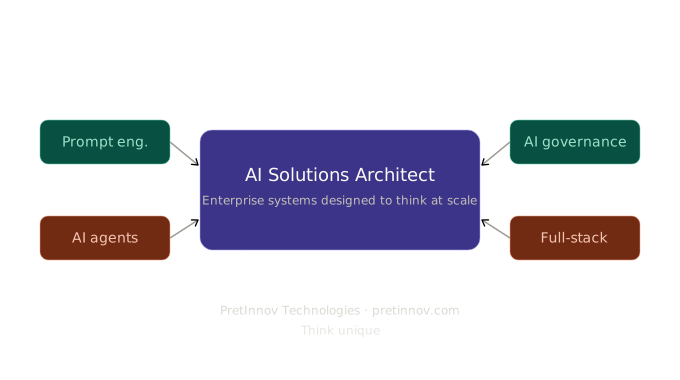
Your AI strategy isn’t failing because your models are bad — it’s failing because nobody architected the system around them. What most enterprises are missing is an AI Solutions Architect: the systems-level designer who turns AI features into AI platforms, and AI platforms into durable competitive advantage.
In 2023, every enterprise bolted ChatGPT onto a workflow and called it transformation. A year later, they hired ML engineers and called that a strategy. By 2025, most had rolled out ten disconnected copilots and called the mess a platform. Then the post-mortems started arriving — hallucinations in customer-facing chat, data leakage through plugins nobody reviewed, agent loops burning through API budgets overnight, and compliance teams discovering their “AI pilots” had zero audit trails.
Now it’s 2026, and the winners are the enterprises that stopped shipping AI features and started designing AI systems. The gap between those two sentences is exactly the job description of an AI Solutions Architect — and if you don’t have one, the next 18 months will get expensive.
The First Wave Was Implementation. The Second Wave Is Architecture.
Most enterprises that “did AI” between 2023 and 2025 did three things. First, they integrated an LLM API into one workflow — support tickets, content generation, or code assist. Next, they stood up a RAG pipeline on their internal docs. Finally, they declared victory and moved on.
However, they skipped everything that actually matters in production: prompt governance, model routing, cost observability, retrieval quality evaluation, agent orchestration, tool-use guardrails, sensitive-data classifiers, red-teaming harnesses, and a policy layer that non-engineers can actually audit.
That skipped work is what we call architecture debt. Moreover, it compounds faster than technical debt because AI systems degrade silently. A hallucinated answer never throws a 500 error. Meanwhile, a prompt that worked yesterday can regress tomorrow because the model vendor silently updated the underlying weights. Furthermore, an agent that handled 100 tasks last week can burn $40,000 in tokens this week because someone changed a single system prompt.
An AI Solutions Architect designs for all of that before it happens.
What an AI Solutions Architect Actually Does
This role didn’t exist in most org charts three years ago. Importantly, it’s not a DevOps engineer with a ChatGPT subscription, nor a data scientist who knows what a transformer is. Instead, it’s a systems-level designer whose job is to make AI behave reliably, safely, and economically at the scale your business actually operates.
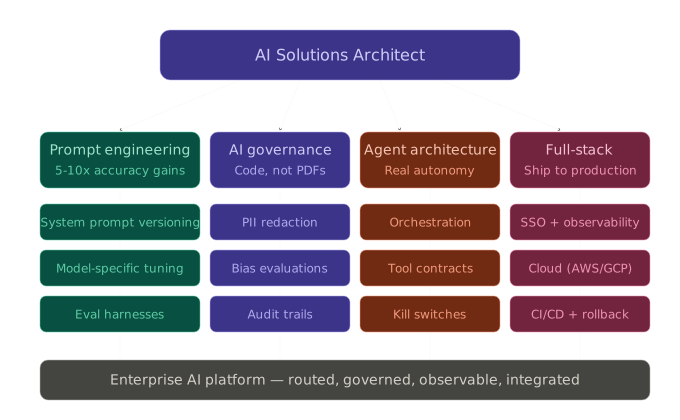
The work breaks into four pillars.
1. Prompt Engineering as a Discipline, Not a Hobby
The gap between a naive prompt and a production-grade one is routinely a 5–10x improvement in task accuracy — at the same model, same cost, same latency. However, most enterprises leave that multiplier on the table because they treat prompting like copywriting rather than engineering.
A proper prompt architecture includes:
- System prompt versioning — every change is git-tracked, reviewed, and rollback-able
- Model-specific tuning — Claude, GPT-4, and Gemini reward different structures; what works for one underperforms on another
- Evaluation harnesses — every prompt change is measured against a held-out test set before it ships
- Prompt injection defense — user input is isolated from instructions with delimiters, classifiers, and sanitization layers
- Structured output contracts — JSON schemas, XML tags, or function-calling signatures that downstream code can trust
Without this discipline, your AI works in demos and fails in production. With it, the same model becomes ten times more useful.
2. AI Governance as Code, Not PDFs
In 2026, “we have an AI policy” is not a governance strategy. It’s a liability.
Specifically, the EU AI Act is now enforced. Similarly, India’s DPDP rules apply to AI-processed personal data. Additionally, industry regulators — RBI for fintech, NMC for healthcare — expect demonstrable controls, not slide decks.
Consequently, an AI Solutions Architect builds AI governance into the runtime:
- Model cards and decision logs auto-generated for every inference
- PII detection and redaction at the prompt and output layer
- Role-based access controls on model endpoints, not just dashboards
- Bias and fairness evaluations baked into the CI pipeline
- Incident response playbooks for the specific failure modes of LLMs — hallucination, jailbreak, tool misuse, prompt leak
When your auditor, your regulator, or your CISO asks “how do you know your AI is behaving?” — the answer is dashboards and logs, not a Notion page.
3. Agent Architecture for Real Autonomy
The shift from chatbots to agents is the defining technical story of 2025–2026. Agents don’t just answer — they plan, call tools, read databases, write files, trigger workflows, and operate for hours without human supervision.
However, that power is also the risk. An improperly architected agent is a faster way to lose data, money, and trust than any system your enterprise has ever shipped.
Architecting AI agents means making deliberate decisions about:
- Orchestration framework — LangChain, CrewAI, AutoGPT, or a custom runtime, each with different trade-offs for observability, cost, and determinism
- Tool contracts — every tool an agent can call is explicitly scoped, rate-limited, and logged
- Memory design — what the agent remembers across turns, what it forgets, what it never stores
- Escalation paths — when the agent hands off to a human, and how that handoff preserves context
- Kill switches and budget limits — hard stops on token spend, tool calls, and loop depth
A good agent architecture is boring. Consequently, it behaves predictably, fails in safe ways, and remains auditable end-to-end.
4. Full-Stack Integration
This is where most AI consultancies break down. Typically, they can build a notebook demo. Yet they cannot ship it into your existing Django monolith, your React frontend, your legacy Oracle warehouse, your Salesforce CRM, and your SOC 2-compliant cloud — all at once, with SSO, with observability, with rollback, with on-call coverage.
For this reason, an AI Solutions Architect is full-stack by necessity. The AI layer is useless if the integration layer is fragile.
The Hidden Cost of Skipping AI Architecture
Enterprises that hired ML engineers without an architect are now discovering the bill:
- Cost overruns of 3–10x on inference bills because nobody designed a model routing layer — why use Opus for a task Haiku solves at a fraction of the cost?
- Silent accuracy regressions from model version bumps that nobody tested for
- Security incidents from prompt injection in customer-facing tools
- Compliance blocks on shipping AI to regulated products because no governance layer exists
- Fragmented tooling — seven teams, seven vector databases, seven prompt libraries, zero reusability
In short, every one of those problems is cheap to prevent and expensive to retrofit. That’s the architect’s entire value proposition.
Why 2026 Is the Inflection Point for AI Solutions Architects
Three things converged this year that make architecture non-negotiable.
First, regulation caught up. The EU AI Act’s high-risk provisions are enforced, India’s DPDP rules are being tested in courts, and US state-level AI laws are multiplying. Consequently, shipping unaudited AI into production is now a legal exposure, not just a reputational one.
Second, agents went mainstream. Multi-step autonomous agents — the kind that read email, update records, execute trades, write code, and operate customer support queues — are now production-ready. However, they are also production-dangerous without deliberate architecture.
Third, model diversity exploded. Back in 2023, enterprises used “AI” to mean “GPT-4.” By contrast, a serious AI system in 2026 routes between Claude Opus, Claude Haiku, GPT-4 variants, Gemini, open-source Llama derivatives, and specialized fine-tunes — based on task, cost, and latency. That routing layer doesn’t build itself.
An enterprise without an AI Solutions Architect in 2026 is an enterprise shipping AI the way companies shipped websites in 1999: ad-hoc, undefended, and about to learn expensive lessons.
How to Vet an AI Solutions Architect
If you’re evaluating candidates or partners, here’s the filter that separates architects from implementers.
Start with their last production failure. Implementers give you a clean story. By contrast, architects give you an incident report — with the root cause, the monitoring gap that missed it, and the systemic fix they shipped.
Next, probe their model routing choices. If the answer is “we use GPT-4 for everything,” walk away. Instead, a real AI Solutions Architect has opinions about when to use Claude vs. Gemini vs. a fine-tuned open-source model — and can justify each with cost and accuracy data.
Then dig into governance. If governance is a policy document rather than a runtime enforcement layer, they haven’t built real systems.
After that, press on agent design. Specifically: how do they bound agent autonomy? What kill switches, what budgets, what audit trails? Moreover, vague answers mean hypothetical experience.
Finally, ask them to draw the system. Whiteboard, Miro, napkin — it doesn’t matter. However, if they can’t diagram an end-to-end AI system on demand, with integration points, observability layers, and failure modes, they’re not architects.
The PretInnov AI Solutions Architecture Approach
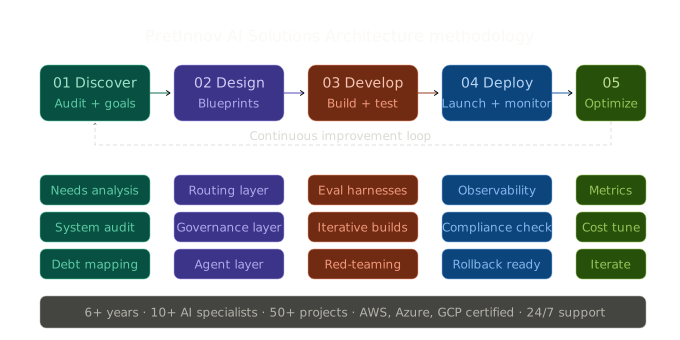
At PretInnov Technologies, we architect AI systems across five deliberate phases: Discover → Design → Develop → Deploy → Optimize.
First, we audit where architecture debt already lives in your stack. Next, we design the routing, governance, and agent layers before writing code. Then we develop with evaluation harnesses from day one. After that, we deploy with observability your compliance team can actually read. Finally, we optimize continuously, because AI systems are living systems — the work doesn’t end at launch.
We’ve shipped this model across Telecom, Healthcare, Ed-Tech, Legal, FinTech, and Data Engineering. Importantly, the pattern holds: enterprises that invest in AI Solutions Architecture early move 2–3x faster afterward, because every new AI feature plugs into a foundation that already handles routing, governance, and observability.
The Uncomfortable Truth
You can keep hiring ML engineers and shipping disconnected AI features. That path works until it doesn’t — usually at the moment your first audit, your first agent loop incident, or your first regulator inquiry arrives.
Alternatively, you can architect the system properly, once, and make every subsequent AI initiative cheaper, safer, and faster.
The enterprises that treat AI as architecture in 2026 will own the next decade. Meanwhile, the ones that treat it as a feature will spend the next decade paying down debt.
We build AI that thinks. More importantly, we build AI that can be trusted to think at scale.
Ready to architect your AI stack properly?
If your enterprise is shipping AI features without a systems-level blueprint — or if you’ve started feeling the architecture debt already — we should talk.
Schedule a Free AI Architecture Consultation →
We’ll audit your current AI footprint, map the gaps, and show you exactly what a production-grade architecture looks like for your stack. No slide decks. No generic playbooks. Just the blueprint your team actually needs.
PretInnov Technologies is an AI Solutions Architecture firm based in Pune, India. We design intelligent systems end-to-end — prompt engineering, AI governance, autonomous agents, and full-stack integration — for enterprises in Telecom, Healthcare, Ed-Tech, Legal, FinTech, and Data Engineering. AWS, Azure, and GCP certified. 6+ years. 50+ projects shipped. pretinnov.com
Think unique.